An opening up in China?

Over the weekend Howard French had a piece in the New York Times in which he argued that, despite appearances to the contrary, China is gradually opening up. Rights have expanded - albeit ever so slightly - government oppression has weakened, and, despite the fact that judges don't have the power to rule independently, the number of lawyers has increased. Pursuant to my previous post, it even appears that China has eased internet restrictions for foreign journalists in the run-up to the Olympics.

There is no denying that the China of today is not the China of yesterday. This holds for a variety of indicators. Yet, the foremost question as regards such extensions of liberty is to what extent they are truly genuine. Are Chinese citizens enjoying 'more' liberties because the CCP has finally decided to rectify its flawed ways, or is this but another instrumental move to further the government's agenda? Arguments exist on both sides of the equation. 

On the topic of rights, I was saddened to hear that Aleksandr Solzhenitsyn passed away this weekend. China could certainly use someone like him.

Noteworthy….

In my daily morning perusal through various blogs and website links, I came across the following project put out by New York-based Human Rights Watch:  China's Olympian Human Rights Challenges. Under the 'Reports' section, one can find a decently-sized collection of annual reports from 1996-2008 on issues ranging from state control of religion, Tibetan exiles, China's HIV/AIDS population and, of course, debate over human rights violations in the run-up to the Olympics. Definitely worth a look!

On a somewhat unrelated manner, the folks over at the World Bank's PSD blog have an interesting post on the place of supermarkets in spurring development. This, as commentary on Reardon and Gulati's recent policy brief, The Supermarket Revolution in Developing Countries. I wonder how many times the word "Wal-mart" appears in that one….

Chinese censor Olympics. Surprise? Anyone?

A front-page story of today's International Herald Tribune reports that:

"Since the Olympic Village press center opened Friday, reporters have been unable to access scores of Web pages — among them those that discuss Tibetan issues, Taiwanese independence, the violent crackdown on the protests in Tiananmen Square and the Web sites of Amnesty International, the BBC's Chinese-language news, Radio Free Asia and several Hong Kong newspapers known for their freewheeling political discourse"

As it turns out, earlier excitement over the 'free reporting' that was to allegedly occur during the Olympic Games was unwarranted: international journalists and spectators will be subject to the same blocks that China places on the Internet for its citizens. Fabulous.

Admittedly, I was among those who hoped the Olympics would open up the black-box that is China. Would, even in some small way, liberalize the country. From my time there and my correspondences with colleagues in Beijing and elsewhere, I've developed a distinct love of and fascination with the "awakened giant" and would like nothing more than for its citizens to enjoy the personal freedoms they rightly deserve. But, as more and more indiscretions surface, I can't help but wonder if Anuradha Amrutesh from Bangalore, India was right: "The Olympics should have never gone to China."

Goodbye Doha, Hello China!

The Doha round of trade talks has ended without producing anything in the way of an agreement. Talks finally broke down after failing to reach a compromise over agricultural import rules. The FT provides details.

Yet unlike those who are now beginning to speak of "collapse," this writer wouldn't go so far as to claim that nothing productive has resulted from the week-long affair. Conversely, I'd argue that the WTO's failure signals important shifts in the international power structure, with some countries - China in particular - quickly rising in the ranks as a  powerful force in global trade wrangling. Indeed, much to everyone's surprise China, together with India, took a prominent part in pressing for import safeguards to shield poor farmers. As Joseph Cheng, chairman of the Contemporary China Research Center at City University of Hong Kong, observes: "China intends to play a more active role as a Third World leader."

The question of China's rise prompts numerous questions, among them that of what this means for Africa. Indeed, many Africans walked away from the Doha talks frustrated that most of the key issues of interest to the African continent were not even discussed, especially the issue of cotton. With Chinese interests so deeply rooted in African soil, it will be interesting to observe the changing face of the international trade debate. I defer to the experts here to speculate on what we might expect.

Regardless, while Doha produced no formal agreements, I would like to proffer two:

1. It's time to reevaluate the effectiveness of the WTO as a trade negotiation and dispute mechanism. A tried and tested critique, to be sure, but this most recent failure gives us more reason to pause.

2. China is becoming an international force to be reckoned with. And, by the look of things, perhaps faster than we thought.

DRC-China aid deal

A colleague of mine who works with the International Crisis Group based in Beijing recently sent me a copy of the contract between the DRC and China on exploitation of mines and construction of infrastructure. You can find a copy of this document here:  drc-chinese-contract (In French).

I also found the following links to be quite useful in shedding light on the DRC-China partnership:

IMF to study China's Congo deal before any accord

China in DR Congo aid deal

China, Congo Trade For What the Other Wants (part of a great NPR five-part series on China's rising power in Africa)

South-South cooperation, or colonialism?

According to an article in today's Business Daily, a Kenyan-based newspaper, Turkey has become the latest emerging economy to join the scramble for African resources, with a continent-wide investment conference to be held in Istanbul in mid-August. 

Turkish focus appears targeted especially at Kenya; bilateral trade between the two countries capped at $90 million just last year. Indeed,  since the country's 2007 presidential upheaval, Turkey has become one of the key source markets for Kenyan consumer goods such as textiles, carpets, furniture and electronics for the newly rich. In February 2007, an article in the Turkish Daily News touted the positive economic byproducts of Kenya's "civil war" for the Turkish cut-flower industry. 

For a country like Turkey -  short on natural resources, desperately seeking admission to the EU and otherwise wanting to maintain and grow its economy - investing in Africa appears a sound business option. What I'm less certain of, however, is how this new phase of South-South cooperation will ultimately benefit the African continent. This is not to suggest that it necessarily won't, but I can't help but wonder: with China, Japan, India and now Turkey (as well as other developing countries - apologies to Japan for lumping it in this category) carving up the African continent, are we witnessing a new phase in productive economic partnerships, or a 21st century version of colonialism?

How soccer explains China

A new twist on an old theory, indeed! A most interesting column in the Washington Post draws parallels between the sentiments borne out of China's apparent ineptitude on the soccer field and those regarding China's place at the world table. A passage for your tasting: 

"Our ongoing soccer misery highlights a basic paradox about today's China. On the surface, we seem to be feeling pretty ebullient, with our fast-growing economy, our newfound wealth and our showcase Olympics, with its peppy theme of "One World, One Dream." We're confident that the future belongs to us. But on a deeper level, many Chinese — especially us men — are unhappy, deeply frustrated and prone to strong, deep-rooted pangs of helplessness and abandonment. And it's all soccer's fault."

Whether or not it is, indeed, "soccer's fault" I don't know, but there is no denying this sense of mixed emotions among many Chinese. Indirectly, this column highlights much of what I have been saying all along: while China goes to great lengths to put on 'face' for the international community, locally inequality, poverty and continued frustrations persist.

Postmodernism comes to China…-ish.

The image of the new China Central Television building (below) built especially for the 2008 Olympics was yesterday's most e-mailed image on Yahoo. 

The building, constructed by the Dutch architectural firms OMA and Arup, clearly breaks with the more traditionalist towers which point towards the sky. Here, instead, one has a continuous loop of horizontal and vertical sections that create their own space and, in a curious yet powerful way, create a distinct sense of energy; one can almost feel the electric currents surging through the building. 

Such a construction would, indeed, be an architectural accomplishment anywhere, but the fact that it has occurred in Beijing is particularly significant. As with all forms of postmodernist architecture, the new CCTV building poses challenges to the limits of modernism and, in turn, to those who hold to the notion of an under-developed China. As noted by a recent article in Vanity Fair, the entire Olympic construction project appears one big attempt to say to the industrialized world: "Whatever you can do, we can do better." And fair enough. 

Beyond it's architectural splendor, the fascinating thing about this seeming wave of postmodernism in China (if one can even go so far to call it that), lies in its connection to politics. There's no denying that architecture has always been inseparable from politics in a broad sense. No less than, say, the Egyptian pyramids, Europe's great Gothic cathedrals were conceived as expressions of power. Similarly, both Albert Speer's grandiose design for Hitler's Berlin and 1960's efforts to bring social improvement through public housing were politically inspired. 

The recent surge of what I like to call "can-do" architecture in China likewise signals the rise of a powerful China - it's impact on African politics and it's relations with the US are enough to make this point clear. Yet within China itself, there appear to be minimal changes; many citizens are actually worse off than in years past. This contrast between the image of a rising China and that of a country struggling to resolve its own domestic problems raises a plethora of questions over whether Chinese politics will be able to match its architecture. As the saying goes, you can talk the talk, but can you walk the walk?  

African-free Olympics?

According to a recent article in the Nigerian "This Day," it appears that the Beijing Olympics may have several fewer Africans than expected.

According the the article, Chinese embassies in Nigeria and other African states are making it difficult for Africans - including heads of state and sports federation leaders- to obtain the necessary documentation to travel to China for the event. Applicants are required to present evidence of ticket purchases, accommodation arrangements, and other pieces of information that some do not yet have or are unable to prove through paperwork. 

If this is indeed the case, such actions, coupled with the 11 July Chinese veto of a UN Security Council resolution to impose sanctions on Zimbabwe put China in a rather curious position vis-a-vis its African colleagues. Especially in the eyes of ordinary Africans, China is increasingly assuming the role of villain. For many Zimbabweans, for instance, the outlook is now one of "us" versus "them," where "them" means Mugabe and his Chinese cronies. 

When China first won the bid for the Olympics, there was much enthusiasm that the games would begin to change the face of Chinese policies. As the Telegraph's Richard Spencer observes, there is little sign of it so far.

The Chinese race for resources

In case you missed it (as I initially did!) FastCompany has an interesting six-part series on China in Africa, with focus on Mozambique, Zambia, Congo, and Equatorial Guinea. The report has, as Chris Blattman notes in his post, an at times alarmist tone referring, for example, to Chinese resource extraction as the "Great Chinese Takeout." An interesting perspective, to be sure.

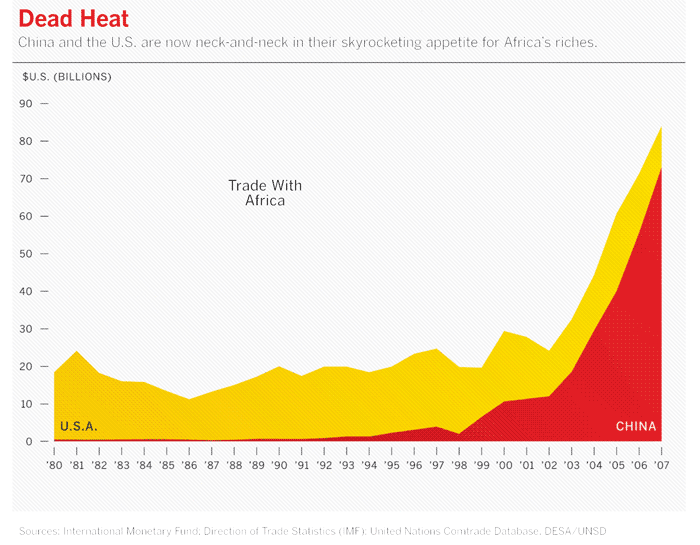
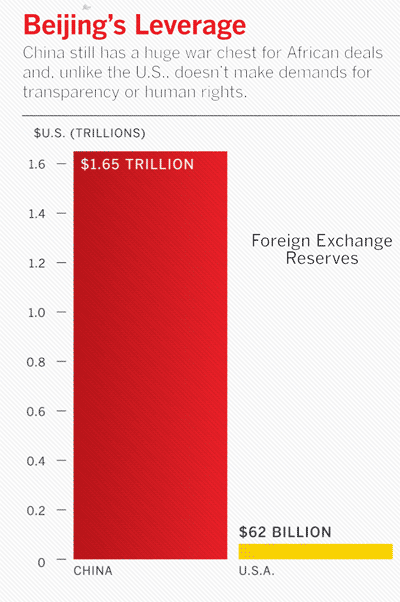
Curious phrases aside, the report offers much valuable information. Particularly in its analysis of the Zambian case (the country with which I'm most familiar) it aptly describes China's role in Zambia's mining industry, its labor 'standards,' access to credit and linkages with the Chinese government. Moreover, it presents quite remarkable bits of data such as these:

For those who previously questioned the significance of China's entry into Africa, these graphs alone should be enough to allay their doubts. What remains to be yet determined, however, is what exactly all this means for African economies. While the report goes a long way in describing the 'what' element of China in Africa it falls short of addressing the 'why' and 'how.' Nevertheless, the series makes for a good read and presents much useful information. I highly recommend it.

And we’re back!… and China is still at it

After a longer-than-expected (though much needed and very much welcomed!) holiday, ChinainAfrica is back with a new look and fresh commentary. There is, indeed, much to discuss and many debates to be had. Not least of which is the recent move by the UN granting China permission to import elephant African ivory from government stockpiles

The move allows China (together with Japan) to participate in a one-time auction, this a consequence of its "dramatically improved ivory enforcement rules." While the one-off trade has raised much criticism from environmental groups, more worrying are the long-term effects of this move: will China really be satisfied with a one-time purchase?

While I certainly cannot claim expertise in the area of China's ivory needs, it suffices to look no further than China's pursuit of other African resources - most obviously, oil - to get a sense of what we may expect. Indeed, despite pressure from human rights and other advocacy groups, Beijing remains infinitely more concerned with its own economic and development needs than those of its partners. This raises the concern, noted by Robbie Marsland, UK director of the International Fund for Animal Welfare, that this one-off allowance will "stimulate demand and create a smokescreen for illegal ivory to be laundered into the legal market." Indeed, signs of such a reality are already beginning to materialize.

It is, of course, too early to speculate about the ramifications of this development. Perhaps, in light of mounting international pressure, China will begin to cater to the concerns of environmental and rights groups. Indeed, Beijing still has a ways to go in substantiating the "partnership" aspect of its African policy. Irrespective of things of come, the recent move by the UN contributes yet another interesting dimension to the Sino-African puzzle and, perhaps most of all, raises questions over the UN's rationale.

ChinainAfrica on ‘examination leave’

Dearest Readers:

I have arrived at that point in the academic year in which life becomes a monotonous routine of living in libraries, consuming amounts of coffee that likely exceed those recommended by the Surgeon General, and falling asleep in random places; this, to compensate for not sleeping proper amounts in an actual bed. Yes, dearest Readers, examination season is upon us.

In preparation for my final examinations - at the end of which I hope to officially claim my MPhil - ChinainAfrica will be on 'academic leave' until after 11 June. Please excuse my absence and do join me again on the other side of things. 

Until then,

Crazy English comes to China


"Conquer English to make China stronger!!" is the slogan of Li Yang's Crazy English course in Beijing, part of the country's program to teach itself as much English as possible before the start of the Olympics this August. 

Li's classes - held often in large arenas and auditoriums in a way analogous to American megachurches - attract large followings, making him a sort of "Elvis of English" for many Chinese. Some followers even go so far as to donate blood just to be able to attend his lectures, while others faint in the crowds as if at a Beatles concert. Whether these ardent fans are actually learning English remains unclear.

What is clear, however, is that this "crazy English" program is one of the few instances of visible populism in China since the Cultural Revolution. Having taught himself English - and in China, no less -  Li exemplifies the possibilities available to common Chinese citizens and, perhaps even more the the CCP itself, is a mobilizing agent for the country's move towards modernization.

Whether Li's courses have anything to do with the CCP is unknown (at least to this writer), though I'd be surprised if some links didn't exist. Li does not claim to love the West, and instead describes it as an imperialist power set on infiltrating China with its customs and culture. His insistence on English is thus derived from a recognized need to close the gap between English-speaking and non-English speaking countries, rather than from any particular affinity towards all things Western.

More than an English course, Crazy English appears to be a way of liberating millions of Chinese from centuries of cultural indoctrination and making available to them a world beyond their own. As noted in a post on Ampontan

"Calling the program Crazy English is a stroke of genius. It provides the students with the justification for liberating themselves from centuries of cultural conditioning that expected people to be reserved and act within a group context instead of being openly assertive as individuals. Crazy people get to do anything they want."

And what many Chinese want, it seems, is to be modern citizens in a modern-day world. Luckily for the CCP, this is what it wants of its citizens, too.

China and…Egypt?

A colleague recently forwarded me an interesting post appearing on Global Voices on the Chinese presence in Egypt:

"Knocks on the door. She told me in broken Arabic: "Wanna buy something Chinese?"

I would normally say: "No, thanks" to them and close the door … But this time my house was full of people so I asked her to come in.

She put the bag she was carrying with her on the floor and started to show me the goods she had. Tablecloths, cloths and cosmetics. I was looking at her, with a lot of questions inside me. Not about what she sold as it's known since they started to invade the country by themselves rather than exporting their goods to us only. But what forced her to do such hard job, and travel away from her homeland with a backpack like a camel hump…"

The post goes on to observe that the Chinese are the only people who will go door to door, arriving in poor countries and selling poor goods. With an estimated 300 million poor in China, however, such desperate manifestations of capitalism are anything but surprising.

The proof is in the pudding: China & Zimbabwe

 Opponents of Robert Mugabe say he plans to use the Chinese weapons to hold onto power by force

Hello all! First, I am most pleased to announce that I have finally emerged from the depths of dissertation writing and, as of yesterday afternoon, am more or less a free woman. This, I hope will translate to more consistent and frequent blog updates. Indeed, many developments have taken place during my absence. I surely cannot even so much as begin to do them all justice in this one entry, so I'll begin with my personal favorite: the Chinese arms shipment to Zimbabwe.

Earlier this month, a shipment of ammunition, rockets and mortar bombs was denied access through South Africa. The weapons were en route to Zimbabwe, and it is believed that they would be used to crush the Zimbabwean opposition following the 29 March 2008 election. On 22 April Chinese Foreign Ministry spokeswoman Jiang Yu noted that the shipment is "normal" and that it is common in international trade to transport goods inland to African countries through the port in Durban, South Africa. 

So many questions can be asked of this one comment that it's actually quite phenomenal. The first that comes to mind is: who in the Chinese government allows for such statements to be made? Anyone who has been tracking African politics in the past month or so can very quickly gauge that the uproar has little to do with the shipment's entry point. It has to do with the shipment itself, and the political situation in its destination state. If nothing else, China's position on the matter is indicative of a seeming ignorance of foreign affairs, which is quickly damaging China's international standing.

But, of course, the Chinese are not ignorant and are well aware of the Zimbabwean plight. By continuing with business as usual they are likely trying to live up to their 'non-interference' policy, which has long fallen by the wayside. As Christopher Clapman observes in his new book (written together with Chris Alden and Ricardo Soares de Oliveira), "In the longer term, no external power with long-term interests in Africa can escape the issue of 'governance', because this is the essential precondition for maintaining stable economic relationships." In case the Chinese haven't yet reconciled themselves to this reality, it's high time they do so - and fast. 

Indeed, there is much speculation over China's motives behind such a shipment, at such a time. Some blame political alliances, enmeshed as they are in unthinkable levels of corruption. Others point to economics and international trade between the two countries. Yet no one, it seems, has the gall to suggest another, more likely, alternative: the Chinese simply don't care. 

Despite their claims of foreign aid assistance, concern for human rights, etc., etc. there is very little proving that the Chinese actually have any interest in such matters. As in Darfur before, the Chinese are little concerned with assisting the people of Zimbabwe or helping to alleviate the situation. To the extent that any assistance will be given, it will be nothing more than a token gesture that will have little to no tangible impact. The arms deal with Zimbabwe is, above all else, profitable for the Chinese. Profit aside, little else matters. China isn't going to be a hero for the African people. Not now, not ever. And with this recent arms shipment the proof, it seems, is in the pudding.

Dissertation-induced absence.

Dear All:

A quick word of apology for my absence. I have been - and continue to be - in the thick of writing up my MPhil dissertation. It will be complete and submitted on 21 April and I look forward to resuming correspondence then. Writing up has been quite a journey, and has brought many new insights. I look forward to sharing them with you soon.

Cheers, aleksandra

Chinatown, Paris.

I have entered that phase enjoyed by every grad student where there is suddenly a light at the end of the tunnel. Albeit quite dim, I am beginning to see the end to my dissertation writing. Thank goodness! To be fair, I'm greatly enjoying this project of thesis writing, as it's allowed me to immerse myself into the cultural and entrepreneurial practices of the overseas Chinese, and come to a greater understanding of issues of migration, identity, and small-scale entrepreneurism, among many others.

The chapter I'm currently working on is the framing chapter, attempting to situate Chinese migration to Africa in comparative perspective. It should come as no surprise that the Chinese are a widely dispersed group, with Chinatowns and ethnic enclaves all over the globe. This reality makes writing both easy and incredibly difficult. Writer's block aside, I am coming to grasp the pervasiveness of Chinese migrant communities. Even where no Chinatowns analogous to those in San Francisco or NYC exist, the Chinese presence cannot - and has not - been ignored.

Such is the case in Paris, where the first French-Chinese man is running for mayor of Paris' 13th district. About 20% of residents in the 13th arrondissement are of Asian origin, representing some 30, 000 people. Nationwide, there are an estimated half-million people of Asian decent. Paris' Chinatown is the biggest in all of Europe.

The 37 year-old Wu is seemingly running on a platform of "let the Asians be seen," calling in part for the building of Chinese gates similar to those that adorn Chinatown in San Francisco, such that "a visitor should know he is in Chinatown." Charming though this concern may be, my hunch is that delimiting Chinatown for Parisian tourists is about as far down the list of concerns as one can get. In a country of increasing multiculturalism the primary concern is with the persistence of the Asian identity and the maintenance of closely formed networked communities.

While fancy gates and overt signs of "Chineseness" aren't particularly necessary to accomplish such ends, they surely never hurt. Like many immigrant communities, the Chinese carry with them a strong sense of identity. Many continue to reside among their own people, with only minimal contact with the host society. They partake in cultural associations - recreational, political and/or cultural - which are often linked to organizations in Mainland China, and maintain close ties with family and friends in China. Such activities are typical of many overseas migrants, but are particularly unique among the Chinese in that they persist beyond the initial stages of migration.

In the Bay Area in California, for instance, many signs over banks, restaurants and other public services are now in Mandarin and English - this, in areas outside of San Francisco's Chinatown. The Chinese initially arrived in California in the 1850s and have held on to their identity since. Similar patterns can be observed across much of North America and Europe. France is the latest case in point.

Why do I bring this up? While it's far too early to speak of such developments in the African context, the Parisian case suggests that the Chinese presence in Africa may in the long-term alter the continent's identity and politics. The establishment of China City in Joburg, South Africa, is perhaps the first step en route to this reality. I am not here laying any normative claims on such developments, but am merely bringing them to the attention of those to whom this is of interest. The possibility of 'Chinatown, Africa' is yet another among many considerations in the puzzle that is China-in-Africa.