Chavez’s China strategy

Chavez appears to be turning away from the US and towards China as the future major importer of Venezuelan oil, according to Forbes' Paul Maidment.

Chavez paid a three-day visit to Beijing in late September during which he and Chinese leaders struck deals to build four oil tankers and to construct or upgrade more oil refineries in China capable of processing Venezuela's crude. PetroChina (nyse: PTR - news people ) just upgraded the Liaoyang refinery to that end. China and Venezuela also agreed to build a refinery in Venezuela's Orinoco Basin and launch a joint oil-development project there, potentially one of the world's largest oil fields.

China currently buys 4% (330,000 barrels of oil a day) of Venezuela's crude. Chavez wants to get that up to 1 million barrels by 2012. China also recently signed a $3 billion oil deal with Iraq, and is meant to begin receiving oil supplies from Turkmenistan in 2009. Coupled with its deals with Angola, Nigeria, Russia, and Sudan - among several others - it seems that "non-interference" has its advantages.

How much is $700 billion?

Duncan Green puts the American bailout in international perspective: 

To put the proposed Wall Street bailout into perspective. $700bn:

  • Would clear the accumulated debt of the 49 poorest countries in the world ($375bn) twice over
  • Is almost 5 times the annual amount of extra aid needed to achieve all the Millennium Development Goals on poverty, health, education etc ($150bn a year)
  • Is about 7 years of current global aid levels ($104bn in 2007)
  • Is enough to eradicate all world poverty for over two years (UNDP  calculates it would take $300bn to get the entire world population over the $1 a day poverty line).

On the other hand it's

  • only a quarter of the cost of the Iraq war ($3 trillion on Joseph Stiglitz' calculation )
  • a half of annual global military spending ($1339 bn)

Those at the World Bank's AfricaCan blog are also speculating on the impact of the crisis on Africa. To this I would add that the current crisis has put China in a rather advantageous position vis-a-vis its African 'friends' - at least for now.

Asia rides high as US economy struggles?

Gideon Rachman has a column in yesterday's FT in which he suggests that the recent US economic troubles may signal a shift in global political power, though perhaps not as quickly as one may think. Citing Pan Wei, director of the Center for Chinese and Global Affairs at Beijing University, Rachman captures the Chinese sentiment:

"My belief is that in 20 years we will look the Americans straight in the eye – as equals. But maybe it will come sooner than that. Their system is in chaos and they need our money to rescue them."

Yet according to Rachman there are three key reasons why this reality may not be so quick to materialize:

  1. Even if the American market is no longer the be-all-and-end-all for China and India, it is still extremely important.
  2. The Chinese economic engine has already been sputtering, for other reasons. In Beijing and Shanghai, the price of smart apartments has been falling sharply, and the Shanghai stock exchange is down 60% over the past year.
  3. The fact that American consumption is falling for the first time in eighteen years inevitably means that China will grow more slowly in the coming year

And, with today's drop in Asian stocks, the global shift surmised by Pan Wei seems less likely.

Turkey and Africa, cont’d

In a series of earlier posts I had noted Turkey's growing interest in forging relations with Africa. According to The Jamestown Foundation, Afro-Turkish relations are indeed an emerging force in South-South cooperation: 

Turkish interest in Africa is underwritten by soaring bilateral trade: while Turkey's trade volume with the entire African continent was $5 billion in 2003, Gul noted that with government encouragement, Turkish-African trade had been increasing annually by double digit figures since 2004 and exceeded $12 billion last year, a figure that his government hoped to increase to $30 billion by 2010

According to the report, it appears that Turkey's approach to developing trade with African nations differs from that of China, or even the US. Unlike the macro-projects pursued by most Western donors (and China), Turkey is concentrated on lower profile development issues such as agriculture, which carries the promise of affecting positive change in the lives of many across the continent. The underperformance of the critical agriculture sector remains a major drag on Africa's development, and has been neglected by both donors and governments over the past two decades.  Turkish assistance may prove to be precisely the boost the continent needs.

New development blogs

During my recent absence from the blogosphere several new and noteworthy development blogs have emerged for your reading pleasure:

Development technology. Literally.

Dell Inc. unveiled four low-cost computer models for emerging markets today. The computers, priced at around $450, are targeted especially at China and India, two of the fastest growing economies.  According to the New York Times:

The move reflects a growing focus by global computer, automobile, consumer goods and other companies on creating products for increasingly prosperous customers in China, India and other emerging economies.

Income inequality and education in China

According to a report released by PREM entitled Rising Income Inequality in China: A Race to the Top, income inequality in China has increased at rapid rates in the past two decades, as noted in Figure 1:

At the same time, strong growth has meant that all income groups have seen pretty substantial economic gains. Authors Luo and Zhu explain:

The dynamics of divergence across these sub-national areas have taken the form of a "race to the top"—meaning that all segments of the population, including the poor with low education in lagging inland rural areas, have experienced gains in average income

Moreover: 

for all eight provinces, rural poverty headcount more than halved from 50.1% in 1989 to 22.4% in 2004; urban poverty headcount fell by a-third from 19.0% in 1989 to 13.5% in 2004

Coupled with these phenomena, however, is an even more interesting one: as income inequality has grown in China, the distribution of capital in the form of education has actually decreased. In other words, access to education has become highly concentrated in wealthier coastal and urban areas and is a fundamental factor underlying the surge in income inequality. Indeed, the increase in returns to education often initially leads to an increase in inequality. As David Dollar observes, however, such changes will ultimately tend to reduce inequality if equality of opportunity, especially equality in access to education, can be achieved over time. 

Long story short: poverty reduction occurs not only when a country opens its economy to the world, but also when it is able to support a sound education system and an educated populace.

Is Turkey pulling a China regarding Darfur?

Sudanese president al-Bashir is among those in attendance at this week's Turkey Africa Cooperation Summit being held in Istanbul. His presence has outraged many human rights activists, who feel that inviting al-Bashir signals Turkish complacency in the Darfur crisis. Among others, the New York based Human Rights Watch has called on Turkey to use the opportunity to support a court case against Bashir, who has been indicted on genocide charges by the ICC. There is little public evidence that such support has been given. 

At a private meeting, Turkish president Gul told Bashir that he should "work hard" to end the violence in Darfur, which is tantamount to telling a small child to 'play nice' in the sandbox, only for him to return to his previous antics as soon as no one is looking. Such requests are unlikely to shake Bashir, who has vowed never to turn any Sudanese over to the ICC, and does little in the way of ending the crisis in Darfur. 

Turkey's human rights record is itself laden with violations, especially as regards military-civilian relations and Article 301 of its constitution which prohibits "denigrating Turkishness." Nevertheless, the country is signatory to various human rights documents, among them the Universal Declaration on Human Rights, the European Convention on Human Rights, and the European Convention for the Prevention of Torture and Inhuman or Degrading Treatment or Punishment. As a country fervently seeking entry into the EU, it is moreover in Turkey's interest to choose its friends and allies carefully, as any misstep may cost it that coveted EU seat.

Yet with China rising in the international arena despite its unwillingness to 'save Darfur,' it is not surprising that a country like Turkey might not express particular concern, either. China's message is in many ways one of strategic and international success coupled with frequent disregard for the West and international doctrines. Under such an approach countries like China continue to gain international dominance and countries like Sudan are let off the hook. It's a dangerous form of realist politics that the global community shouldn't be too quick to tolerate.

China’s gender imbalance

In Monday's Vox column Esther Duflo observes that the ramifications of China's One Child policy are steadily beginning to be felt

Among 16-25 year olds today, there are nearly 110 boys for every 100 girls. Boys are having trouble getting married. And young men, particularly single ones, have more behavioural problems and commit more crimes than young women … Since 1998, the number of crimes has risen 13% per year on average. Seventy percent of criminals arrested are between 16 and 25 years old, and 90% are male

Concerns a that such a demographic imbalance may result in violence, economic crisis, an imminent rise of prostitution, and kidnapping are also beginning to surface. Unfortunately, it could take some fifteen years before this imbalance rights itself, likely more given that the CCP intends to continue the policy for at least another decade, with few modifications.

Turkey-Africa Cooperation Summit underway

Taking place under the theme 'Solidarity and Partnership for a Common Future,' the four-day event began yesterday in Istanbul. This first summit meeting is intended to allow the leaders of both sides to take stock of the progress made in various areas of development cooperation and look at the future of their relations with a view to further developing and diversifying them.

In an earlier post I noted the benefits such partnership may boast for Turkey, the most obvious being access to resources. Not surprisingly, the country is now eager to sign cooperation accords with Angola where oil reserves are around the 20 billion barrel mark. Sudan's president Bashir is also in attendance at the Summit, likely for similar reasons.

The trade volume between Turkey and the continent allegedly rose by 140% between 2003 and 2007, and 55% in the first half of 2008. 

Turkey has declared 2008 as 'Africa's Year.' Africa also had a "year" in 2006, which belonged to the Chinese, and another in 2007 which was claimed by the Indians. At this rate I'm curious to see who will claim the continent come 2009.

The resurgence of decentralization

Decentralization has been a buzz word in the development world for quite a while, as it is believed that local governments are more accountable to their constituents than are centralized governments. This logic seems to be making a resurgence in Somalia, where Somali intellectuals and Western academics are pushing for a form of government that might be better suited to Somalia's fluid, fragmented and decentralized society: rebuilding Somalia from the bottom-up.

It is called the building-block approach. The first blocks would be small governments at the lowest levels, in villages and towns. These would be stacked to form district and regional governments. The last step would be uniting the regional governments in a loose national federation that controlled, say, currency and the pirate-infested shoreline, but did not sideline local leaders.

While decentralization has certainly been proven effective in various African locales, it has likewise heralded in problems of resource deficiency, wasted resources and policy overlap. While decentralization may solve some of Somalia's problems, it may equally exacerbate others.

Chinese vino on the horizon

In an earlier post I speculated about the emergence of a booming Chinese wine market. An article a this month's Men's Vogue seemingly confirms these musings. Indeed,

a new crop of wineries, many of them joint ventures with Western capitalists, are now busy scouring the country's 3.7 million square miles for those elusive terroirs…. 

The tasting notes for the new Chinese wines remain somewhat muddled, most likely because the wines are still bizarre to Western palates. Irrespective, it appears that China is flexing its muscles in more than just international politics.

Alignment, that really isn’t

"Harmonization" and "alignment" have been key catch-phrases in the international aid community for quite some time, gaining particular salience in 2005 with the signing of the Paris Declaration. The main idea is that multilateral and bilateral donors will somehow align their operational policies, procedures and practices with existing poverty reduction strategies (or other development frameworks) in recipient countries, thereby avoiding unnecessary overlaps and rendering aid overall more effective. This push for harmonization is especially pronounced with respect to the MDGs.

Yet in the run-up to the 2008 Third High-Level Forum on Aid Effectiveness it seems that little progress has been made towards such alignment, at least among the major multilateral aid organizations. In today's Vox column OECD's Helmut Reisen presents the following table:

Table 1 Unclear institutional assignment to the MDGs

Selected multilaterals working on the Millennium Development Goals

MDG / Thematic area

Main multilaterals

Other multilaterals with a role

MDG1: Eradicate extreme poverty and hunger

UNDP, World Bank, AfDB, AsDB, IFAD, EC, FAO, WFP

CGIAR, IADB

MDG 2: Achieve universal primary education

World Bank, UNICEF, UNESCO

UNFPA, UNRWA

MDG 3: Promote gender equality and empower women

UNDP, World Bank, UNIFEM, UNICEF

UNFPA

MDG 4: Reduce child mortality

WHO, UNFPA, UNICEF

World Bank, WFP, UNRWA

MDG 5: Improve maternal health

WHO, UNFPA

World Bank, WFP

MDG 6: Combat HIV/AIDS, malaria, and other diseases

UNAIDS, World Bank, WHO, UNDP, UNFPA, UNICEF

UNIFEM

MDG 7: Ensure environmental sustainability

UN Habitat, World Bank, AsDB, UNDP

CGIAR, UNIDO

MDG 8: Develop a global partnership for development

World Bank, EU, UNDP, UNIDO, ILO, UNCTAD

UNDP

Human rights

OHCHR

UNIFEM

Conflicts and humanitarian emergencies

UNCHR, OCHA, ECHO, WFP, UNICEF, WHO

UNDP

Source: OECD Development Centre, "Financing Development: Whose Ownership?", Paris, 2008, Chapter 2.

As Jonathan Dingel writes: "When everyone is responsible, no one is."

The China factor in the Russo-Georgian conflict

A report in The Voice of America notes that Georgia has asked China to use its influence to push for a resolution to a territorial flare-up with Russia. According to the report, Georgia's ambassador to China, Zaza Begashvili, made no comments on the Chinese response, but remains optimistic that:

as a member of the U.N. Security Council, [China] will express its opposition to this aggression against an independent state

As the WSJ's Gerald Seib notes, it probably isn't feasible to try to play China and Russia directly off against each other, as was sometimes possible when they were the two Communist behemoths during the Cold War. Nonetheless, I'm curious to see what China will do in this situation. Let's consider the two most obvious options:

Option 1: China does not assist Georgia 

The likelier option if you ask me. As a still emerging power China is heavily dependent on its strategic partnership with Russia and isn't about to make any move that would place that partnership in jeopardy. Furthermore, if China intends to stick to its policy of "non-interference" (which, if one considers China's activities of the past five or so years, appears to be debunk regardless), interfering in the conflict becomes even more unlikely. While China may express its concern verbally, we all know that actions speak louder than words.

Option 2: China assists Georgia

I'm still trying to play this one out in my head, so bear with me. At present I can think of only two conditions under which any such thing would be likely. The first is China's image in the international community, especially now during the Olympics. Then again, if China was concerned with its image, I doubt the country would be complicit in the Darfur and Zimbabwean crises, among others. Nor would it bear such an atrocious human rights record with respect to its own people. Right. Condition #1 scratched. 

Condition #2: Oil. The WSJ again reports that the conflict in Georgia is placing grave doubt on the country's reliability as an energy corridor bringing Caspian crude to global oil markets, and sending shockwaves through the world-wide supply chain. Indeed only today BP shut down a pipeline over security fears in Georgia. It's no secret that China is resource hungry, pursuing oil wherever it can get its hands on it. If the Chinese are to intervene (and that's a big "if") then I speculate that their only reason for doing so would be over oil. Indeed, China and Georgia maintain friendly relations and I doubt China would want to lose a potential oil resource. Then again, much depends on China's relations with other key players like Iran and various African states like Angola, Nigeria and Sudan from which China derives most of its oil.

China’s newfound love of wine

There has been much debate over whether the Olympics will change China. As it stands the debate is far from over; indeed it has only begun. Inevitably, though, the Chinese are becoming a force in the international arena even, it seems, when it comes to wine. In Friday's Slate Mike Steinberger writes: 

the balance of wine-buying power is already shifting eastward: Chinese collectors have furiously sought out one first-growth Bordeaux, Château Lafite; and Hong Kong, which recently lifted all duties on wine, is now poised to rival London and New York as a hub of the global wine trade

Moreover:

The country's wine consumption jumped more than 50 percent during the first half of this decade and is on course to increase another 70 percent during the second half. These numbers have caught the eye of all sorts of Western wine luminaries, who have begun to take China very seriously

Is a "Made in China" wine label on the horizon?

China puts on face for the world as Olympics begin

The Olympics are underway in Beijing, with what no doubt was a spectacular opening ceremony. For the next 16 days the world (or at the very least this blogger) will sit glued to the television as the world's top athletes battle for guts and glory. The Athenians definitely knew what they were doing. 

But does the world know what China is doing? Really? Sure everyone knows China is a Communist country and most people have some idea of what that means. China's list of human rights violations - both with respect to its own people and others [insert African country of choice here] - is quite appalling, as is its foreign relations record quite generally, with few exceptions. But from my conversations with those not directly involved in researching China's domestic and/or foreign relations, few fully grasp what's at stake. 

An opinion piece in today's Wall Street Journal goes some way in shedding some light on the issues, concluding with a rather optimistic tone that the Olympics may in the long term herald in a freer China. In a somewhat less optimistic fashion, Human Rights Watch argues that "the Chinese government and IOC wasted a historic opportunity for reform." The New York-based Human Rights in China similarly issued a press release on the worsening human rights situation in China.  And in the recent edition of Foreign Affairs, Elizabeth Economy and Adam Segal write of China's embarrassing coming-out party, set against a background of poor environmental standards, increased pressure over Sudan and its poor record of accountability and transparency - just to name a few. The list goes on and on. 

Sadly, the China the world will see for the next sixteen days is not China, per se, but China as the CCP would like for it to appear. Open. Free. Strong. Dare I say it - Liberal. Ironically, this vision may be among the few things China and its critics agree on. A crucial difference, though, is the means by which to attain it. 

Nevertheless, human rights violations aside, the Olympics promise to bring much phenomenal competition and countless spectacular performances - both on and off the fields. I, for one, am very much looking forward to it. Human rights violations aside.

The battle for African telecoms

In recent days I've had a slew of information about the development of information and communications technology (ICT) in Africa come across my desk, the most useful of which is Ryan Hahn's post "All Things Africa and ICT" on the PSD blog site. It appears that Africa's telecoms sector is quickly becoming the new "it" thing within the development community. While most of the mobile operators are home-grown, countries like China, India and Japan are not far behind in the scramble for contracts. 

According to the most recent edition of Africa-Asia Confidential, "China is assuredly in the lead." In March 2008, a US$69 million agreement was signed between Angola's MundoStartel and China's ZTE Corporation to develop telephone networks in Angola. This past June, Tanzania's Excellentcom Ltd signed a $180 million contract with China's Huawei Technologies. Under the agreement, Huawei Technologies will start building Excellentcom's network to enable it to cover the whole country within 13 months. Similar deals have been signed between China and Kenya, Zimbabwe, Sudan, Algeria, and other countries across the continent. 

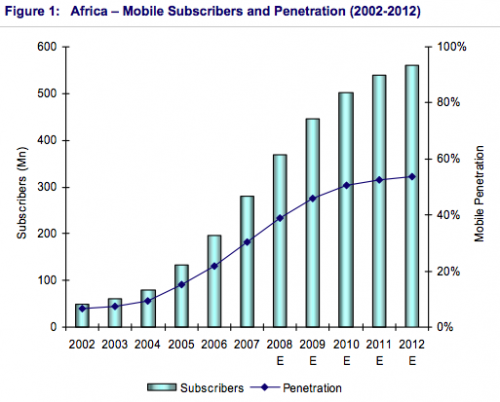
It may be pure coincidence, but mobile subscriber and penetration figures have nearly quadrupled since China's entry into the continent in 2000:

With other countries fighting to enter the market - new among them Kuwait's Zain and UAE's Etisalat - the African telecoms sector will definitely be one to keep an eye on in the coming months.

American perceptions of a rising China

On August 4 the Chicago Council on Global Affairs released a short report of findings on American perceptions toward the rising power of China. Among the report's key findings are the following:

  • 76% of Americans believe China's economy will grow as large as the US economy
  • 42% of the above population believes this will be mostly negative, with 51% claiming it will be equally positive and negative
  • Despite these concerns, 64% of the sampled population nevertheless thinks that the US should "undertake friendly cooperation and engagement" with China, while 33% feels the US should actively work to limit China's rise

So, in short the report arrives at two conclusions: (1) Americans fully grasp the reality of China's rise. Good. And, (2) they presently reject any drastic policy measures, holding to the opinion that friendly cooperation is the way forward. Yes, but under what conditions?